


DSIP 10mg Peptides
Built for disciplined laboratories, this DSIP vial delivers a clean, stable research standard you can count on from the first preparation to the last aliquot.
This DSIP (Delta Sleep-Inducing Peptide) research material is presented as a lyophilized peptide vial, classified within neuropeptides and prepared for controlled laboratory workflows. The format is a dry, shelf-stable powder engineered for precise handling and storage by qualified personnel. Total content per vial is 10mg, supporting consistent study design, standardized methods, and repeatable results across experiments where DSIP is the target analyte.
- Each vial contains 10mg of DSIP, a neuropeptide referenced in scientific literature for investigations into sleep architecture, circadian signaling, and stress-response pathways in controlled models.
As a lyophilized material, this vial is designed to integrate smoothly into laboratory routines that require measured preparation, careful reconstitution, and accurate aliquoting. Researchers value the dry, stable format for its ease of storage and its compatibility with common laboratory handling practices. Appearance and dissolution characteristics support methodical setup, enabling teams to maintain tight control over variables while focusing on the integrity of the study.
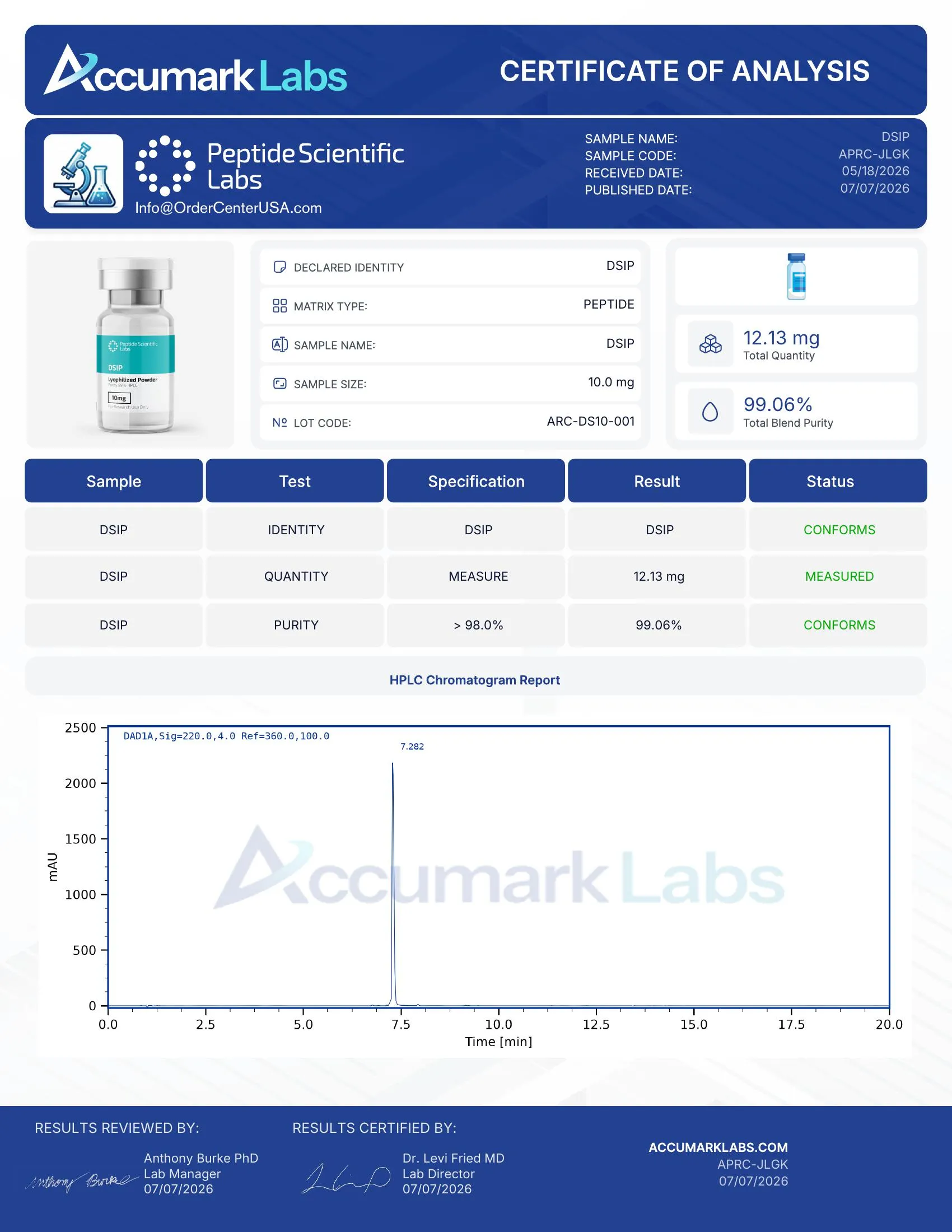
Peptide Scientific Labs emphasizes clarity and control at every step. Each lot is produced and handled under rigorous quality systems with identity and purity verification as central checkpoints. Materials are packaged for laboratory use, lot-coded for traceability, and labeled with essential research information. Our USA-based operation maintains a disciplined, standards-first approach—prioritizing consistency, careful handling, and transparent documentation that supports informed decision-making in the lab. Lot documentation is available upon request to assist with internal quality reviews.
Quality and compliance you can trust: premium sourcing, controlled handling in research-appropriate environments, and methodical testing for identity and purity. No consumer additives or flavors—only the peptide research teams require. All materials are intended strictly for laboratory research. For research use only. Not for human consumption, medical, or veterinary use.
- Most orders ship within 24 hours and arrive within 3 to 5 days of leaving our warehouse.
- Shipping is free on orders of $99+ (except Hawaii and Alaska).
- All orders ship in discreet packaging via USPS Ground Advantage mail.
Delivery restrictions vary by state.

This Product Contains

Customer Reviews
- 1
- 2
- 3
- 4
- 5

Reviews (1)


DSIP 10mg Peptides
Frequently Asked Questions
What is DSIP?
DSIP stands for Delta Sleep-Inducing Peptide, a small experimental peptide long discussed in neuroendocrine literature. Its mechanism has never been completely settled, which is important to say plainly. The correct framing is that DSIP remains a research peptide of interest in sleep and stress-related models, not a settled clinical product.
What is DSIP typically studied for?
Researchers usually connect DSIP with sleep architecture, circadian regulation, stress response, and neuroendocrine signaling. Because the literature is mixed, strong claims should be avoided; the most accurate wording is that DSIP is studied in those areas, with ongoing uncertainty around its precise mechanism and reproducibility.
What are neuropeptides?
Neuropeptides are short chains of amino acids produced primarily by neurons and used as signaling molecules within the nervous system. Unlike classical neurotransmitters, which are small molecules stored in synaptic vesicles, neuropeptides are synthesized as larger precursor proteins and then enzymatically processed into their active short-chain form before being released.
Examples of widely studied neuropeptides include oxytocin, vasopressin, substance P, and neuropeptide Y. They are investigated in connection with mood, stress response, memory, pain signaling, social behavior, and a wide range of other neurobiological processes in research models.
How do neuropeptides differ from classical neurotransmitters?
Classical neurotransmitters such as glutamate, GABA, dopamine, and acetylcholine are small, non-peptide molecules. They are typically synthesized directly in the presynaptic terminal, stored in small clear vesicles, and released for fast point-to-point signaling across the synaptic cleft. Their action is usually short-lived and terminated by reuptake or rapid enzymatic breakdown.
Neuropeptides, by contrast, are larger, are produced from longer precursor proteins in the cell body, and are stored in dense-core vesicles. They are generally released under higher-frequency stimulation and tend to produce slower, longer-lasting, and more modulatory effects — often operating over larger spatial distances within the nervous system.
Where are neuropeptides produced in the body?
Neuropeptides are produced primarily in neurons of the central and peripheral nervous system, but they are also found in many non-neuronal tissues. Major sites of production include the hypothalamus, pituitary gland, gut enteric nervous system, adrenal medulla, and various endocrine cells throughout the gastrointestinal tract.
This broad distribution is one reason neuropeptides are such a large research area — many of them act at the intersection of nervous, endocrine, and immune signaling. Peptide Scientific Labs supplies synthetic neuropeptide reference compounds for in vitro laboratory use only.