


GHK-Cu 50mg Peptides
Bring consistency and clarity to your cosmetic peptide research with a vial prepared for disciplined, repeatable work.
This GHK-Cu lyophilized vial provides a lab-ready presentation of a copper-binding tripeptide with a total strength of 50mg per single-unit vial. As a cosmetic research peptide, the powder is freeze-dried to preserve integrity, enable controlled reconstitution, and support reliable assay development. The format is designed for precision from the outset—offering a clean, stable starting point for method design, optimization, and comparative studies.
- Each vial contains 50mg of GHK-Cu, widely examined in cosmetic science for peptide–copper complex research related to matrix support pathways, visible skin appearance models, and antioxidant response mechanisms in controlled settings.
The lyophilized presentation is engineered for predictable handling in the laboratory. The powder reconstitutes cleanly with suitable laboratory solvents per protocol, supporting accurate dilution schemes and streamlined method development. Its compact, secure vial format helps simplify storage, labeling, and chain-of-custody documentation within controlled environments. Researchers can expect a stable, uniform presentation intended to minimize variability introduced by handling.
Because lyophilization reduces water activity, the peptide is packaged to protect integrity during transport and storage, helping maintain consistency across studies. Each unit is lot-coded for traceability, facilitating documentation, auditing, and reproducibility across multi-site or long-term projects.
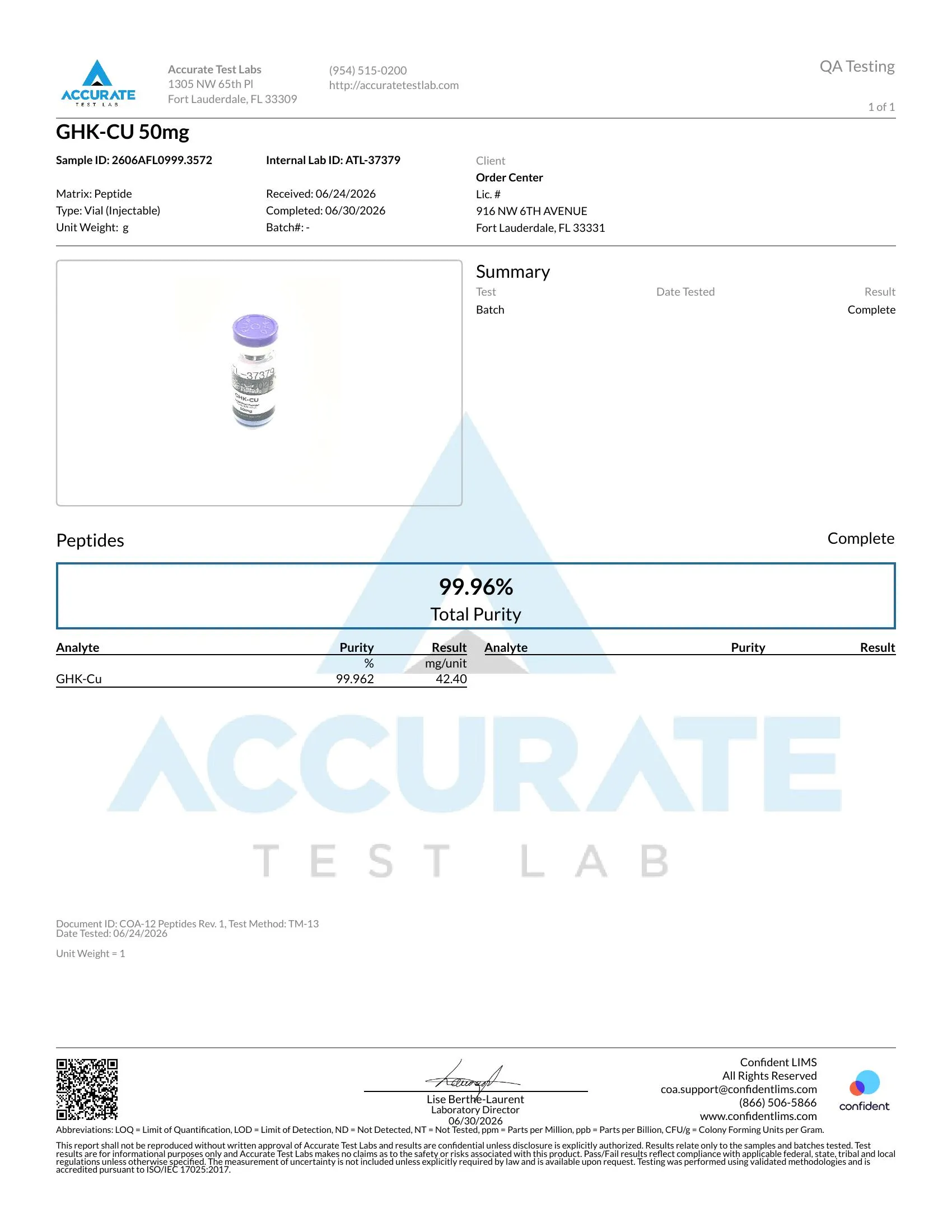
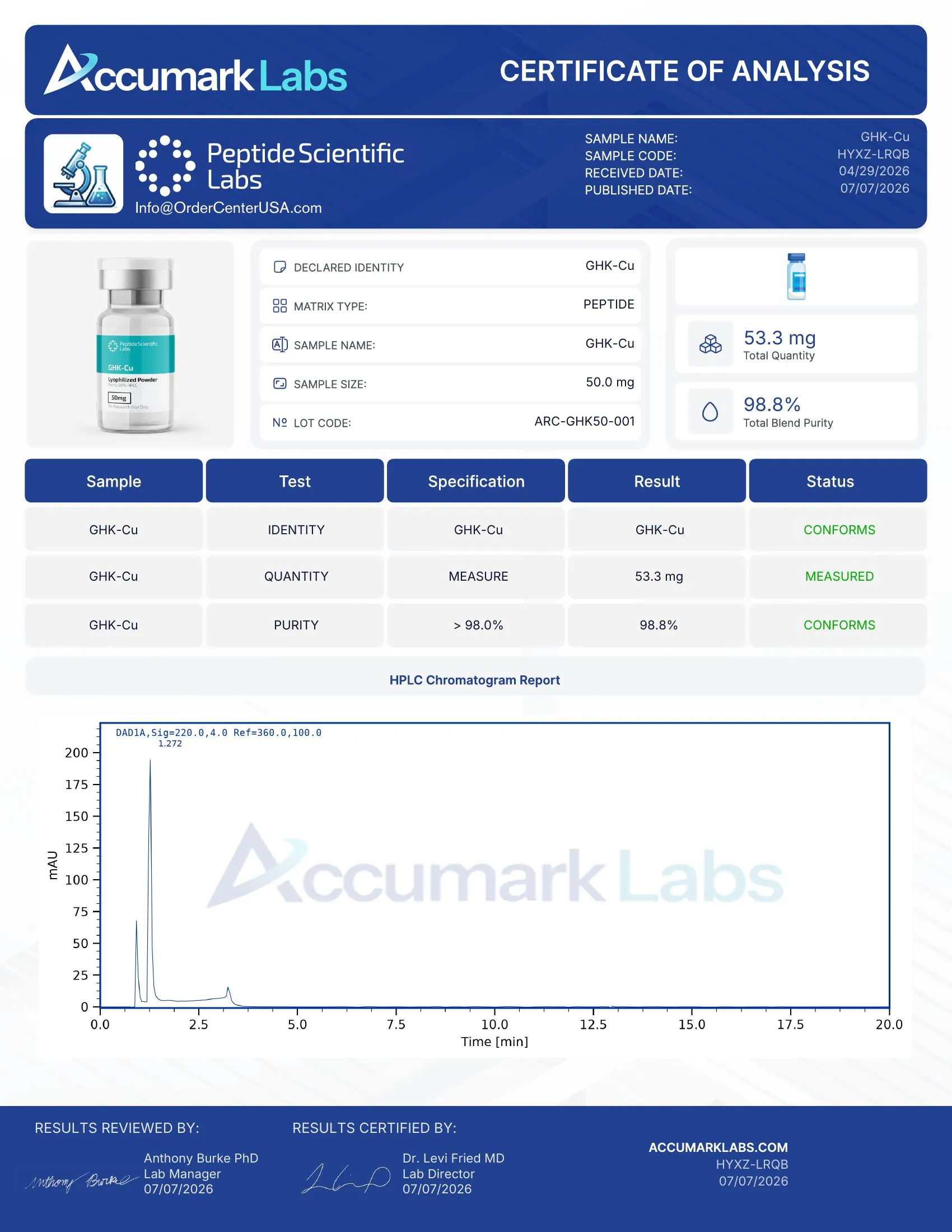
Peptide Scientific Labs is a USA-based supplier focused on rigorous standards. Lots are tested to confirm identity and purity, prepared in controlled environments, and packaged to safeguard quality from fulfillment to receipt. Our process emphasizes careful sourcing, meticulous handling, and transparent documentation—key factors for laboratories that require dependable materials and consistent performance.
Research Use Only. Not for human consumption, medical, diagnostic, or veterinary use. Handle with appropriate laboratory PPE and practices. Store and reconstitute according to your facility’s SOPs, protecting from light and moisture as appropriate to your protocol. For qualified laboratory personnel only.
- Most orders ship within 24 hours and arrive within 3 to 5 days of leaving our warehouse.
- Shipping is free on orders of $99+ (except Hawaii and Alaska).
- All orders ship in discreet packaging via USPS Ground Advantage mail.
Delivery restrictions vary by state.

This Product Contains

Customer Reviews
- 1
- 2
- 3
- 4
- 5

Reviews (2)


GHK-Cu 50mg Peptides
GHK-Cu 50mg Peptides
Frequently Asked Questions
What is GHK-Cu typically studied for?
Researchers most often study GHK-Cu for collagen-related signaling, dermal remodeling, wound repair, extracellular-matrix regulation, and cosmetic-science applications. It is commonly discussed where skin quality and tissue regeneration overlap, but the compliant wording is still that these are research interests, not approved cosmetic or medical claims.
What is GHK-Cu?
GHK-Cu is a copper-binding tripeptide, short for glycyl-L-histidyl-L-lysine copper. It is one of the most recognized peptides in skin and wound-healing research because copper binding changes its biological activity. On a research website, it should be described as a laboratory peptide studied for repair and remodeling pathways.
How do peptides relate to collagen?
Collagen itself is a large protein built from long polypeptide chains of amino acids — primarily glycine, proline, and hydroxyproline — organized into a characteristic triple-helix structure. Shorter peptides enter collagen research in two main ways: as signaling peptides studied for their ability to influence collagen expression in fibroblast models, and as carrier peptides that deliver cofactors relevant to collagen synthesis, such as copper.
So peptides and collagen are not the same thing, but they are biochemically related. Peptides are studied as small informational molecules that interact with the cellular machinery responsible for producing collagen, which is itself a much larger structural protein.
What is the difference between signal, carrier, and neurotransmitter peptides?
Signal peptides are short sequences studied for their ability to mimic fragments of larger proteins and trigger downstream responses in cell models — for example, fibroblast responses relevant to extracellular matrix research. Carrier peptides are studied primarily for their ability to transport trace elements or cofactors, such as copper, into cell systems. Neurotransmitter-modulating peptides are investigated in models of neuromuscular signaling and, in cosmetic-adjacent research, sometimes as structural analogs of botulinum-like sequences.
These are research classifications, not therapeutic categories. All of them are studied in vitro, and the distinctions reflect mechanism-of-action hypotheses rather than any approved clinical use.
What are cosmetic peptides?
Cosmetic peptides are short chains of amino acids studied for their interactions with pathways relevant to skin biology — including collagen expression, extracellular matrix assembly, pigmentation signaling, and barrier function. They are commonly grouped into signal peptides, carrier peptides, enzyme-inhibitor peptides, and neurotransmitter-modulating peptides based on their research mechanism of action.
In a research context, cosmetic peptides are investigated as model ligands for fibroblast response, in vitro wound-healing assays, and skin-equivalent models. The compounds offered by Peptide Scientific Labs in this category are lyophilized research materials intended solely for controlled laboratory investigation and are not cosmetics, drugs, or consumer products.