


GLP-2 TRZ 40mg Peptides
Confidence begins with standards you can verify.
GLP-2 TRZ 40mg is supplied as a lyophilized peptide vial designed for controlled laboratory use, providing a clean, stable format and a dependable GLP-series analog for method development and analytical work. This unflavored, research-only preparation delivers a total of 40mg per vial and is produced with strict handling protocols to support reproducibility across studies.
- Each vial contains 40mg of GLP-2 TRZ, supporting in vitro receptor and pathway investigations, assay optimization, and stability and degradation profiling where a consistent GLP-2 analog is required.
Developed for non-clinical environments, this lyophilized format is chosen to help preserve integrity during storage and transport. When handled by qualified personnel using appropriate sterile technique, the material is intended to reconstitute to a clear solution for immediate incorporation into laboratory protocols such as binding assays, signaling assessments, and other analytical workflows. The controlled presentation and documented lot specifications aim to reduce variables and streamline method transfer between teams or facilities.
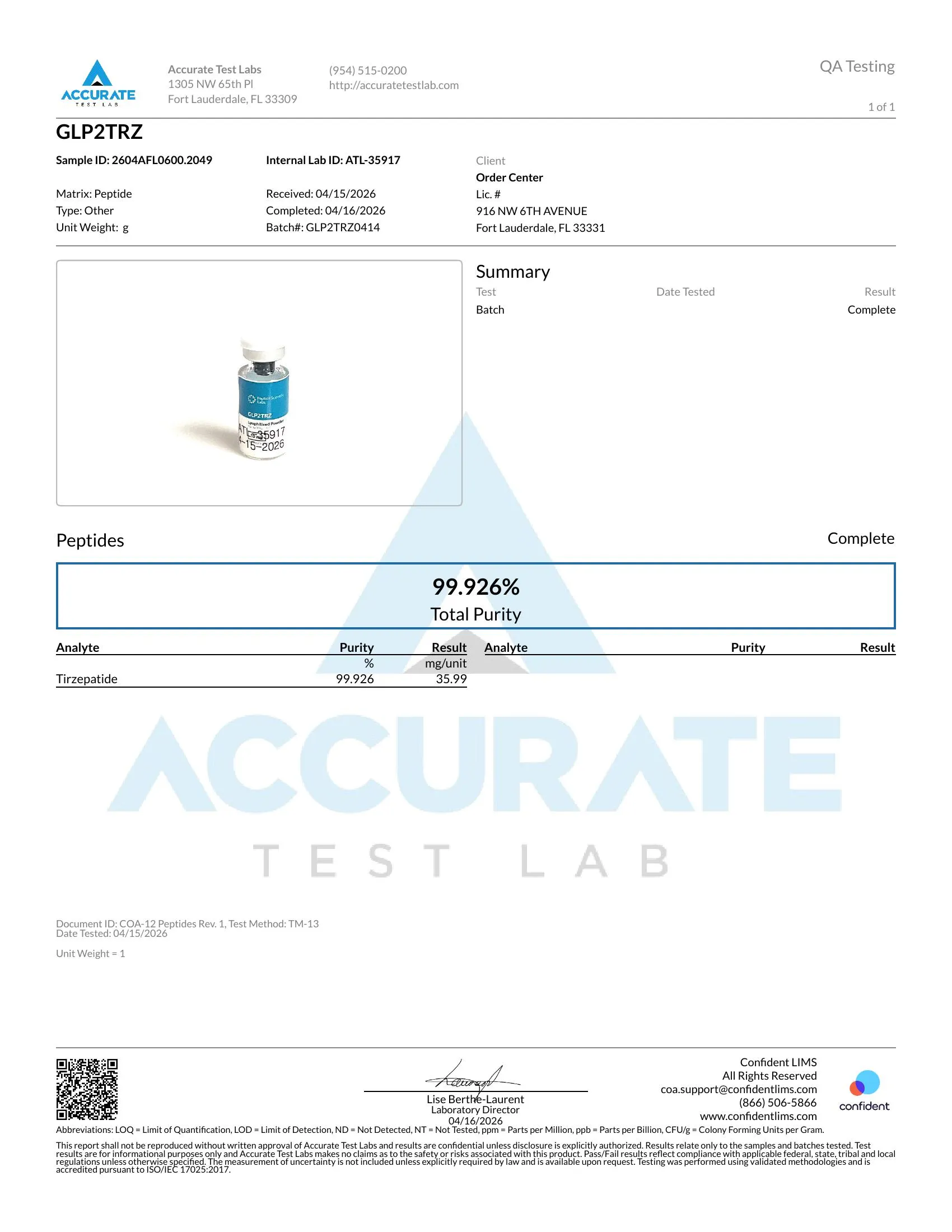
Every vial is prepared and packaged with attention to critical quality attributes, including identity, purity, and consistency. Lots are verified by advanced analytical methods such as HPLC and mass spectrometry to confirm peptide content and profile. Sterile filtration and endotoxin screening support clean bench practices, while tamper-evident packaging and clearly labeled lot information enable traceability from receipt through data reporting. Certificates of Analysis are available by lot to assist with documentation and compliance requirements inside quality-managed laboratories.
Peptide Scientific Labs is a USA-based supplier focused on rigorous standards, transparent specifications, and dependable service. Our peptides are produced under GMP-aligned processes, handled with care, and shipped to maintain product integrity. This product is intended strictly for laboratory research use only, not for human or animal consumption, clinical applications, or diagnostic procedures. For best results, store, handle, and dispose of according to your institution’s safety protocols and applicable regulations.
Choose GLP-2 TRZ 40mg when your work depends on clarity, consistency, and a research partner committed to precision at every step.
- Most orders ship within 24 hours and arrive within 3 to 5 days of leaving our warehouse.
- Shipping is free on orders of $99+ (except Hawaii and Alaska).
- All orders ship in discreet packaging via USPS Ground Advantage mail.
Delivery restrictions vary by state.

This Product Contains

Customer Reviews
There are no reviews yet. Be the first to write a review!

Frequently Asked Questions
What is GLP-2 TRZ?
GLP-2 TRZ appears to be a supplier-specific name for a GLP-2-oriented research compound or analog. Because the 'TRZ' suffix is not a universal scientific naming standard, the exact structure should be confirmed from the product specification or COA. Conservative site copy should therefore describe it as a GLP-2-pathway laboratory compound.
What is GLP-2 TRZ typically studied for?
GLP-2-related compounds are usually studied for intestinal growth, mucosal integrity, nutrient-absorption physiology, and gut-repair signaling. The safest FAQ wording is to explain those GLP-2 research themes while noting that the exact behavior of this product depends on the specific analog being sold.
What are GLP peptides?
GLP peptides — glucagon-like peptides — are a family of peptides derived from the post-translational processing of the proglucagon precursor. The main members are GLP-1 and GLP-2, both of which are produced primarily by intestinal L-cells. GLP-1 is studied in the context of insulin secretion, glucose metabolism, and appetite signaling, while GLP-2 is investigated for its role in intestinal epithelial biology.
A number of synthetic analogs and research compounds exist in this category, including semaglutide-class and tirzepatide-class sequences, as well as dual- and triple-agonist research peptides. All GLP peptide products from Peptide Scientific Labs are lyophilized research materials intended solely for in vitro laboratory investigation.
How do GLP analogs differ from native GLP hormones?
Native GLP-1 has a very short half-life in plasma — on the order of a few minutes — because it is rapidly degraded by the enzyme dipeptidyl peptidase-4 (DPP-4). GLP analogs are engineered peptides that modify the native sequence or attach additional groups such as fatty acid chains, in order to resist DPP-4 degradation, extend half-life, and optimize receptor binding.
This extended stability is what makes GLP analogs useful in research as practical tools for studying the GLP-1 and related receptor systems in controlled experiments. The analogs differ from native GLP hormones primarily in their pharmacokinetic profile and, in some cases, their receptor selectivity across the GLP-1, GIP, and glucagon receptor families.
What is the difference between GLP-1, GLP-2, and GLP-3 in research?
GLP-1 and GLP-2 are both produced from the proglucagon precursor. GLP-1 is studied in connection with the GLP-1 receptor, insulin secretion, and appetite signaling, while GLP-2 is studied primarily in connection with the GLP-2 receptor and intestinal epithelial biology. The two peptides share a common precursor but have different receptor targets and research focuses.
GLP-3 is not a classical endogenous peptide in the same way as GLP-1 and GLP-2. The term is sometimes used as a research label for engineered or triple-agonist peptides that combine activity at GLP-1, GIP, and glucagon receptors in a single molecule. In this sense, GLP-3 in research usually refers to a designed multi-target compound rather than a naturally occurring hormone.