


KPV 10mg Peptides
Built for precision-driven labs, this vial delivers dependable peptide quality from a brand where standards come first.
The KPV lyophilized peptide vial from Peptide Scientific Labs provides a focused, single-ingredient format designed for controlled research workflows. Each unit contains 10mg total peptide in a freeze-dried presentation to support accurate handling, reliable reconstitution, and consistent aliquoting. KPV (Lysine-Proline-Valine) is presented without flavors or additives, offered as a clean research material for method development, comparative analyses, and exploratory studies.
Ingredients: KPV.
- Each vial contains 10mg of KPV, a melanocortin-derived tripeptide investigated in preclinical models for modulatory activity along inflammatory pathways, support of epithelial barrier function, and broader tissue-protective signaling.
This is a non-edible, lyophilized peptide formatted for laboratory use only. Researchers can expect a uniform, freeze-dried matrix intended for reconstitution according to established protocols and study design. The vialed format supports controlled handling, precise aliquoting, and compatibility with standard laboratory equipment. When appropriately reconstituted, solutions are prepared for immediate method development or storage per internal SOPs. Clear labeling, batch coding, and a tamper-evident closure help maintain chain-of-custody practices and traceability throughout the research process.
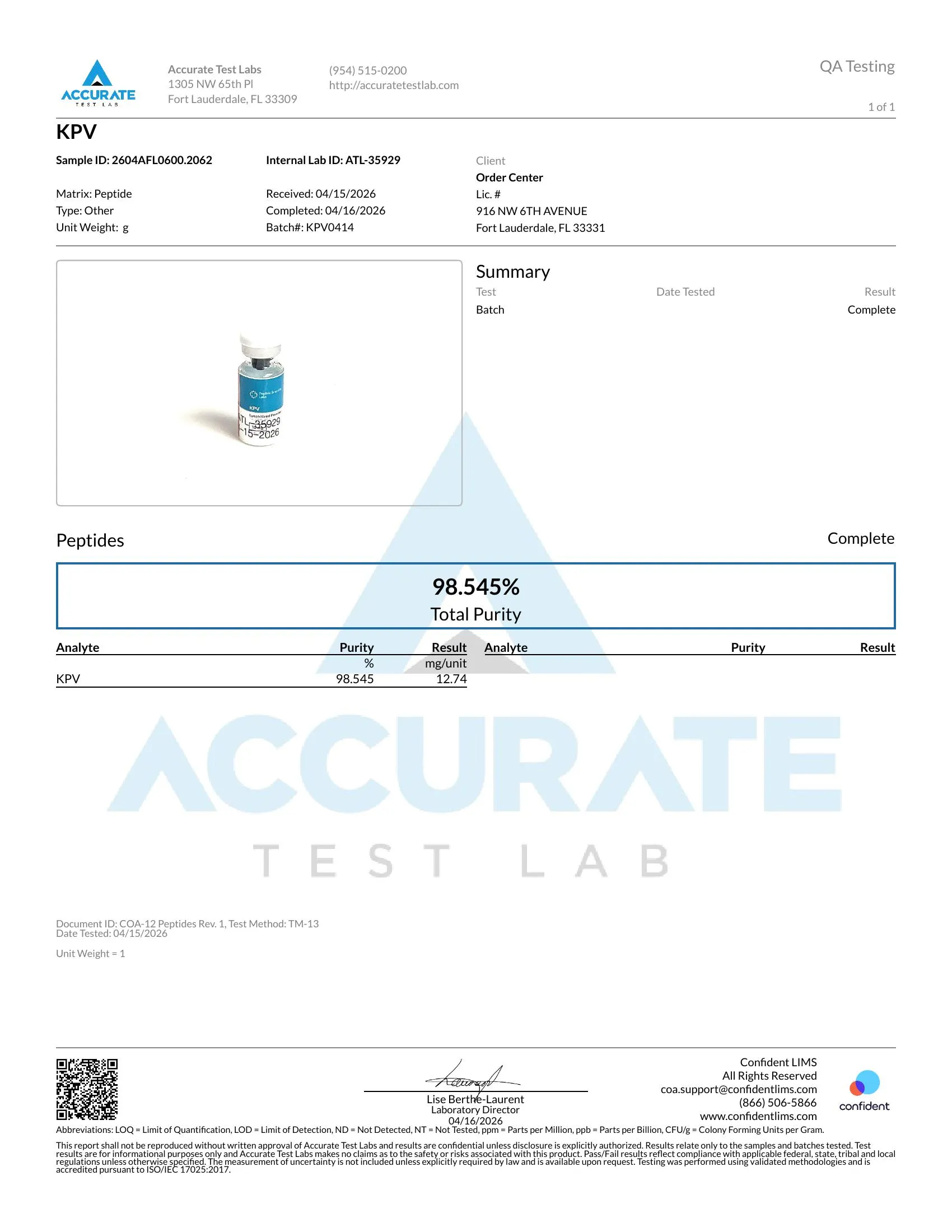
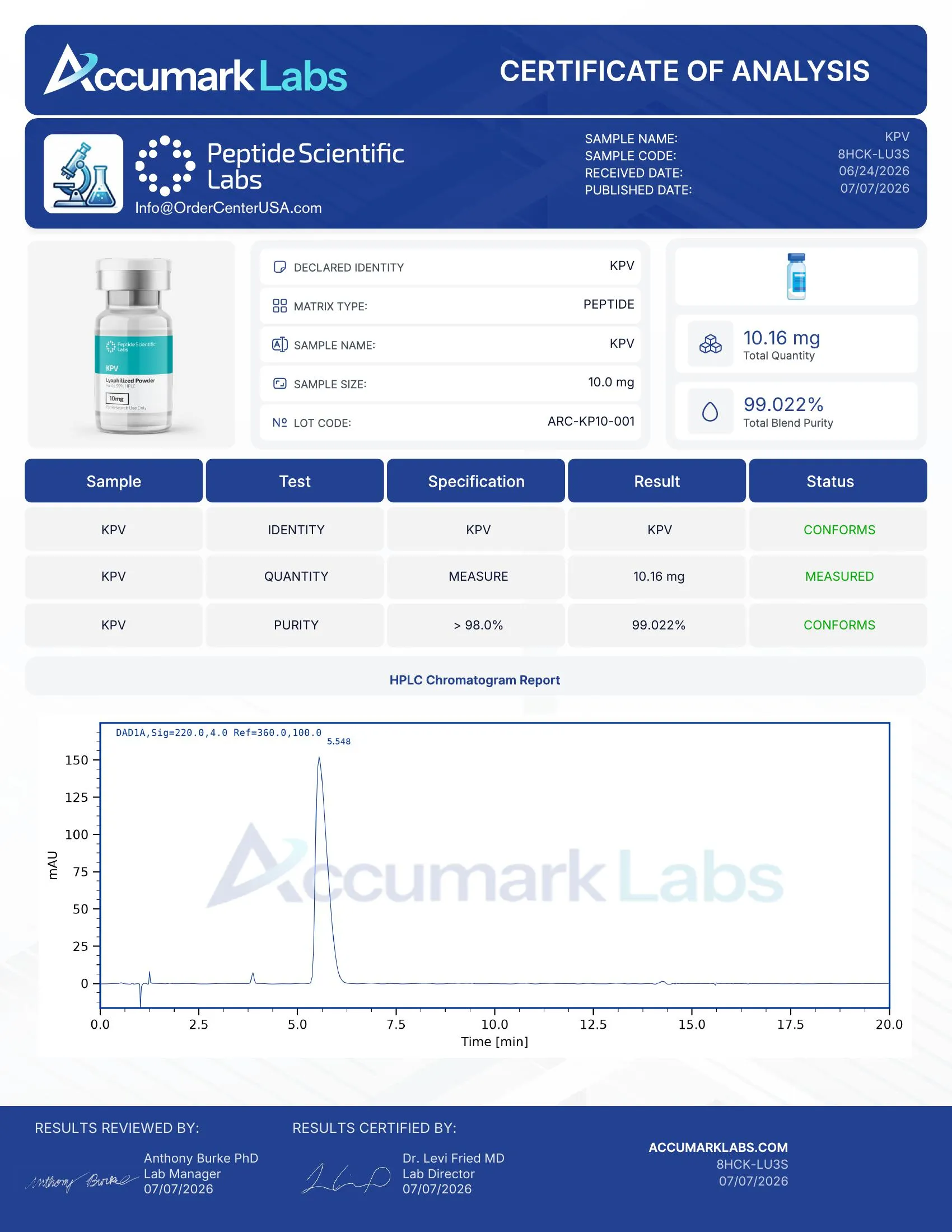
Peptide Scientific Labs operates with disciplined quality controls to help ensure consistency from lot to lot. Every batch is produced in the USA and undergoes analytical verification for identity and purity, including high-performance liquid chromatography and mass spectrometry assessments. Lot-specific documentation is available to support method validation, data integrity, and audit readiness. Products are sealed in clean, lot-coded vials and handled under controlled conditions to maintain integrity through fulfillment.
Research Use Only: This material is intended for laboratory research and development. It is not for human or veterinary use, and not for diagnostic, therapeutic, or clinical applications. Handle with appropriate laboratory PPE and aseptic technique. Peptide Scientific Labs prioritizes transparency, rigorous standards, and careful handling—delivering peptides that reflect the precision and reliability modern research demands.
- Most orders ship within 24 hours and arrive within 3 to 5 days of leaving our warehouse.
- Shipping is free on orders of $99+ (except Hawaii and Alaska).
- All orders ship in discreet packaging via USPS Ground Advantage mail.
Delivery restrictions vary by state.

This Product Contains

Customer Reviews
- 1
- 2
- 3
- 4
- 5

Reviews (1)


KPV 10mg Peptides
Frequently Asked Questions
What is KPV?
KPV is a short tripeptide derived from the C-terminal region of alpha-melanocyte-stimulating hormone. Unlike full melanocortin peptides, it is mainly discussed in the literature for anti-inflammatory and epithelial-barrier-related research. On a site page, it should be framed as a research peptide for inflammation and barrier-biology studies.
What is KPV typically studied for?
Researchers most often study KPV in models involving inflammatory signaling, intestinal or epithelial barrier function, and wound-related immune response. The accurate wording is that it is investigated for those pathways in preclinical systems, not that it is an established treatment for inflammatory disease.
What role do peptides play in tissue research?
Peptides play multiple roles in tissue research. Some act as signaling molecules studied for their effects on fibroblast activity, angiogenesis, and extracellular matrix assembly. Others are investigated as modulators of inflammatory pathways relevant to tissue damage and recovery. A third group serves as reference compounds in assay development and analytical workflows.
Because peptides can be synthesized with very precise control over sequence and purity, they are particularly useful in research models where specific molecular interactions need to be isolated and studied. This makes peptides a common and valuable tool across cell biology, regenerative research, and pharmacological investigation.
What are repair peptides?
Repair peptides is an informal research category referring to short peptides studied in the context of tissue recovery, extracellular matrix remodeling, and cellular responses to damage. Well-known examples investigated in this space include BPC-157, TB-500 (a thymosin beta-4 fragment), and KPV, each of which has been studied in different models of cellular stress, inflammation, and tissue repair.
The category groups together peptides that share a research focus rather than a strict biochemical family. All repair peptides offered by Peptide Scientific Labs are lyophilized research materials intended exclusively for in vitro investigation and are not drugs or therapeutics.
Why are repair peptides studied in recovery models?
Repair peptides are studied in recovery models because short peptides often represent active fragments of larger endogenous proteins that naturally participate in tissue maintenance. By synthesizing these fragments in isolation, researchers can study their individual contributions to processes such as cell migration, angiogenesis, collagen deposition, and inflammatory modulation under controlled conditions.
This approach allows investigators to build mechanistic hypotheses about recovery pathways without the complexity of the full-length parent protein. It also provides reference standards for analytical work. As with all categories on Peptide Scientific Labs, these materials are strictly for laboratory use.