


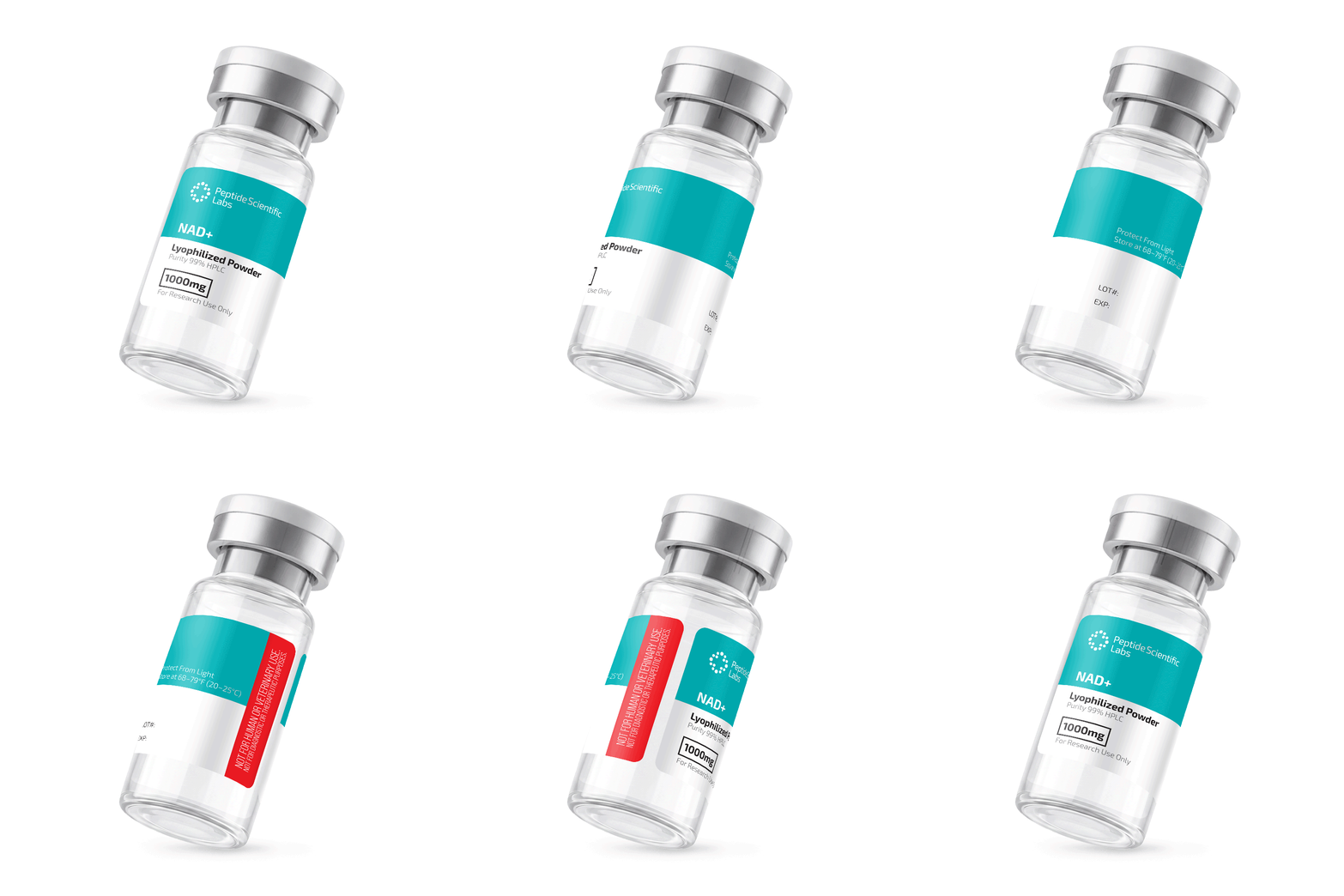


NAD+ 1,000mg Peptides
Engineered for dependable consistency, this NAD+ lyophilized vial is prepared for researchers who demand precision from every batch.
This NAD+ research material arrives as a lyophilized powder in a single-vial format, providing a straightforward, stable option for controlled laboratory handling and method development. The active material is nicotinamide adenine dinucleotide (NAD+), a widely studied redox cofactor. Total content per vial is 1,000mg, offering a clear, easy-to-account quantity for protocol planning and inventory control.
- Each vial contains 1,000mg of NAD+, a central redox cofactor commonly investigated in cellular metabolism, enzymatic pathways, and biochemical assays, enabling precise and reproducible experimental design.
As a non-edible laboratory material, this lyophilized vial is intended for preparation into solution, bench-scale testing, and exploratory research workflows. The dry, lyophilized format supports careful aliquoting and minimized moisture exposure during handling. Appearance is typically white to off-white. Researchers may reconstitute according to their validated procedures and target assay conditions using appropriate laboratory-grade diluents. No buffers, excipients, or additives are included unless explicitly stated on the accompanying documentation, allowing controlled customization for specific experimental needs.
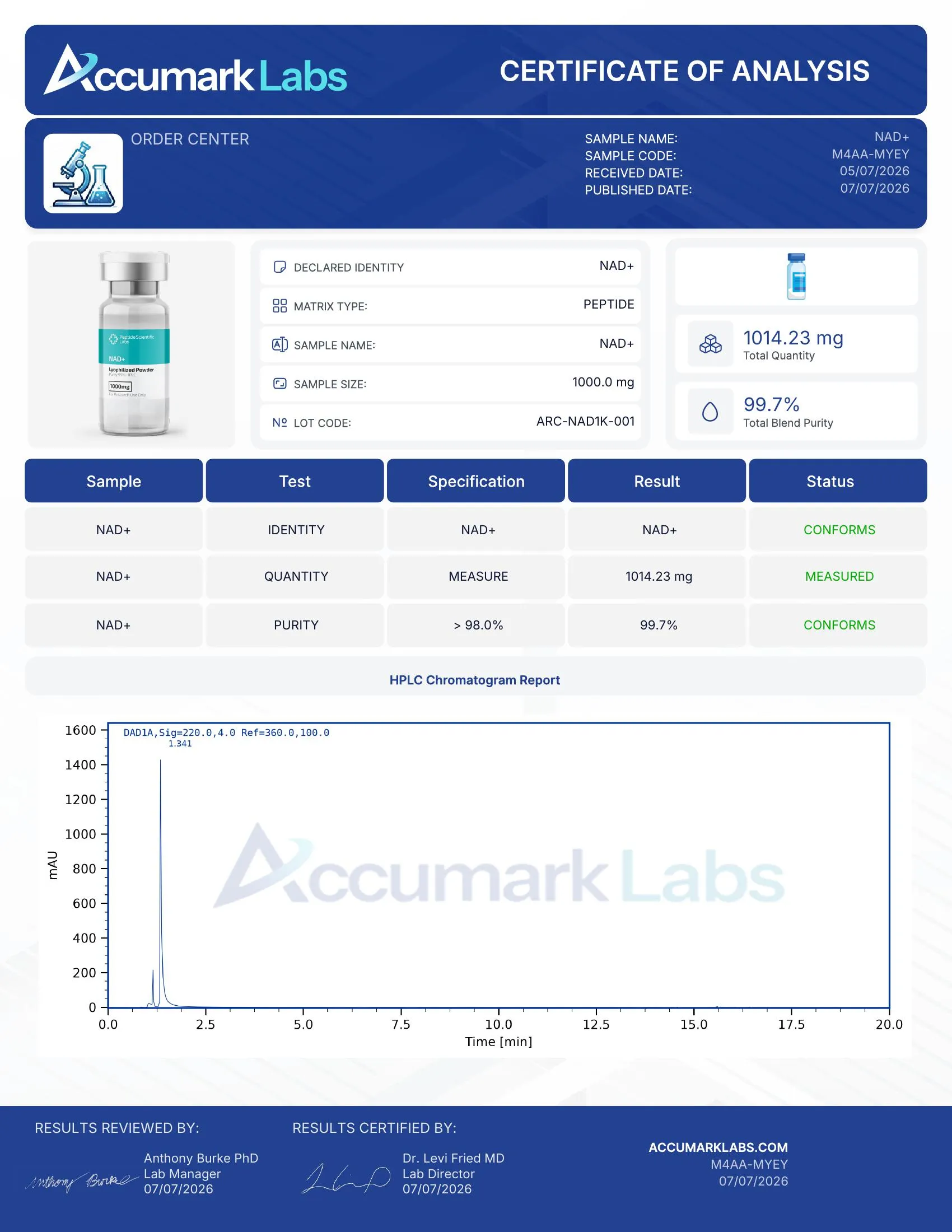
Peptide Scientific Labs takes a rigorous, standards-first approach to sourcing and handling. Lots are produced and packaged with strict process controls, and each batch undergoes analytical testing for identity and purity to support reliable research outcomes. Products are sealed in tamper-evident packaging, shipped with care, and supported by transparent documentation to aid method development and record-keeping.
For laboratory research use only. Not for human or veterinary use. Not a drug, food, or cosmetic. Handle with appropriate PPE and laboratory practices. Store according to established institutional protocols and consult available documentation before use.
- Most orders ship within 24 hours and arrive within 3 to 5 days of leaving our warehouse.
- Shipping is free on orders of $99+ (except Hawaii and Alaska).
- All orders ship in discreet packaging via USPS Ground Advantage mail.
Delivery restrictions vary by state.

This Product Contains

Customer Reviews
There are no reviews yet. Be the first to write a review!

Frequently Asked Questions
What is NAD+?
NAD+ is a core cellular coenzyme involved in redox reactions, mitochondrial metabolism, and several signaling enzymes such as sirtuins and PARPs. It is not a peptide, so it should not be described as one. The accurate website framing is that NAD+ is a laboratory compound studied for energy metabolism and cellular repair pathways.
What is NAD+ typically studied for?
Researchers usually study NAD+ in relation to mitochondrial function, cellular energy production, stress response, DNA-repair-related biology, and aging-associated metabolic decline. A useful FAQ should keep the wording mechanistic and research-based rather than making sweeping longevity promises.
Why are vitamins paired with peptide research?
Many vitamins serve as precursors for coenzymes that are essential in the biochemical pathways peptides interact with. For example, B-complex vitamins are precursors for coenzymes involved in amino acid metabolism, redox chemistry, and methylation pathways — all of which intersect with peptide biology. Including vitamin reference materials alongside peptides allows researchers to run more complete experiments without sourcing components from multiple suppliers.
This pairing is particularly common in metabolic, mitochondrial, and longevity-related research, where peptide signaling and vitamin-dependent coenzyme activity are often studied in parallel.
What are peptide cofactors?
In biochemistry, a cofactor is a non-protein chemical that is required for a protein or peptide to carry out its biological activity. Common cofactors include metal ions such as copper, zinc, magnesium, and iron, as well as small organic molecules known as coenzymes — many of which are derived from vitamins.
Peptide research often involves cofactors in two ways: as necessary components of certain peptide activities (for example, copper in GHK-Cu), and as reference materials used alongside peptides in enzymatic and metabolic assays. The Vitamins & Cofactors category on Peptide Scientific Labs provides such supporting research materials in lyophilized form for laboratory use.
What is the role of NAD+ and B-vitamins in peptide studies?
NAD+ (nicotinamide adenine dinucleotide) is a central coenzyme in cellular metabolism, involved in redox reactions and in the activity of enzymes such as sirtuins and PARPs. It is derived from niacin (vitamin B3) and is widely used in research on cellular energy metabolism, aging, and mitochondrial function — areas where peptides such as MOTS-c and SS-31 are also studied.
Other B-vitamins, including B12 (cobalamin), serve as precursors for coenzymes involved in one-carbon metabolism and methylation, which are relevant to a wide range of peptide-related research. Supplying NAD+ and B-vitamins alongside peptide reference materials enables more integrated laboratory studies of these interconnected pathways.