


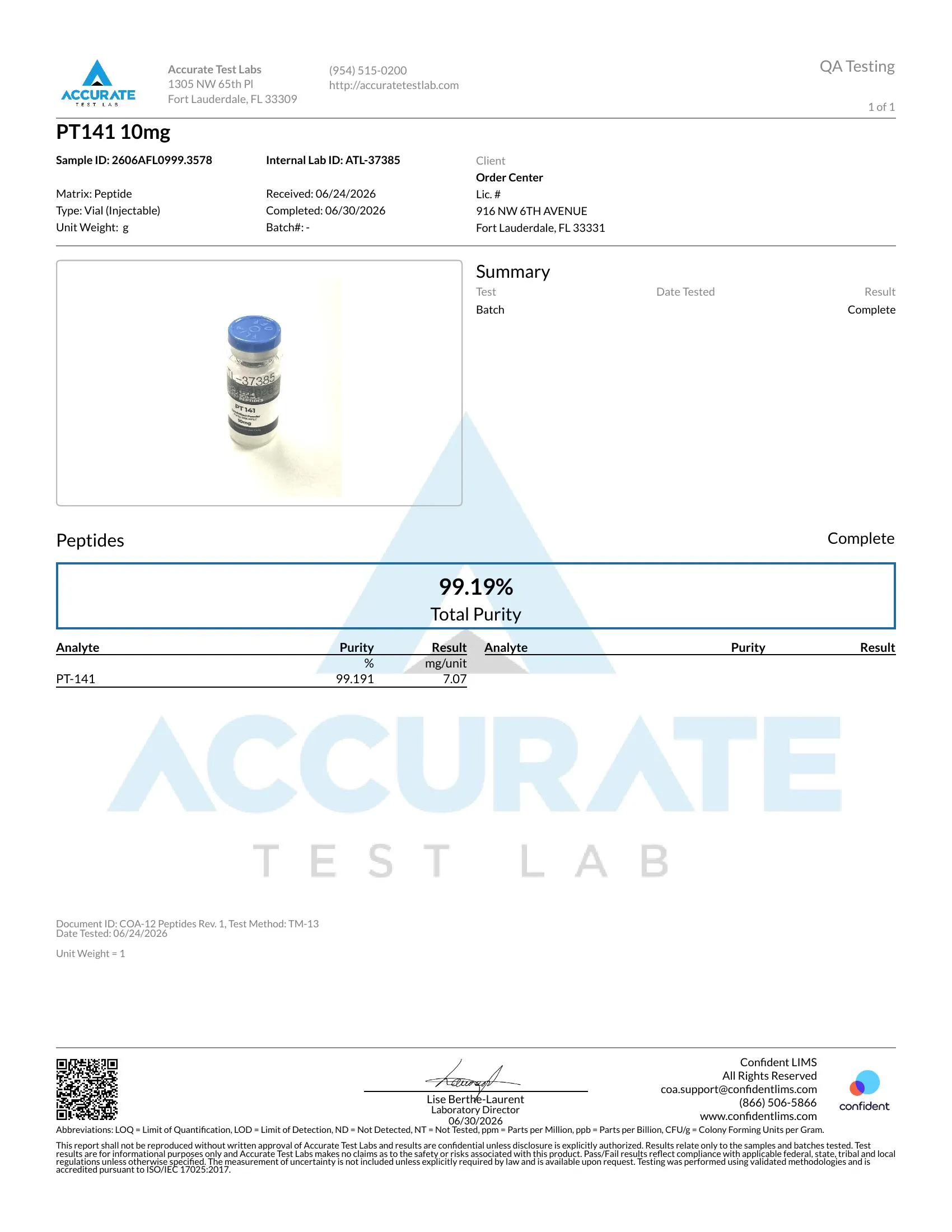
PT-141 10mg Peptides
Built for disciplined research, this peptide delivers dependable consistency from the first experiment to the last.
This Bremelanotide (PT-141) lyophilized peptide vial from Peptide Scientific Labs provides a research-focused melanocortin analog in a clean, laboratory-ready format. Presented as a peptide lyophilized vial with a total strength of 10mg, it is designed for controlled handling, precise study design, and repeatable results in professional settings.
- Each vial contains 10mg of Bremelanotide (PT-141), a melanocortin receptor agonist characterized in the literature for activity at MC3R and MC4R, frequently investigated in studies exploring neuroendocrine signaling, melanocortin pathway mechanisms, and related receptor-mediated responses.
As a non-edible research material, this lyophilized format supports careful reconstitution and accurate aliquoting by qualified professionals. The white to off-white powder provides a practical starting point for protocol development, receptor-binding evaluations, and method validation workflows where batch-to-batch consistency is essential. The 10mg fill offers flexibility for study scaling, comparative assays, and reference standard applications that benefit from traceable composition and measured handling.
Researchers value the lyophilized presentation for its practicality in storage and sample integrity. Vials are intended to be handled with appropriate laboratory technique, using suitable diluents and aseptic processes consistent with institutional standards. Appearance, clarity after reconstitution, and documentation should be reviewed against laboratory requirements before use in any protocol. Each unit is lot-coded to support traceability, documentation retention, and streamlined inventory control within regulated or quality-conscious environments.
Peptide Scientific Labs is a USA-based supplier focused on integrity at every step—from careful raw material qualification and controlled manufacturing to rigorous lot verification. Each batch is produced in a quality-driven environment and evaluated using analytical methods designed to confirm identity and assess purity. Supporting documentation is maintained for transparency and made available to research customers who require clear specifications and consistent performance.
Research Use Only: This peptide is intended solely for laboratory research. It is not a drug, food, or cosmetic, and is not intended for human or veterinary use. No clinical, therapeutic, or diagnostic claims are made. By prioritizing purity, consistency, and documentation, Peptide Scientific Labs provides a dependable foundation for researchers who require precision without compromise.
- Most orders ship within 24 hours and arrive within 3 to 5 days of leaving our warehouse.
- Shipping is free on orders of $99+ (except Hawaii and Alaska).
- All orders ship in discreet packaging via USPS Ground Advantage mail.
Delivery restrictions vary by state.

This Product Contains

Customer Reviews
There are no reviews yet. Be the first to write a review!

Frequently Asked Questions
What is PT-141 typically studied for?
Researchers most often study PT-141 for melanocortin-mediated behavior, arousal-related neurobiology, and central nervous system receptor signaling. The compliant way to present it is to emphasize the receptor class and research context, not to market it with direct lifestyle or sexual-performance claims.
What is PT-141?
PT-141, also known as bremelanotide in the scientific literature, is a melanocortin receptor agonist. It is very different from tissue-repair or growth-hormone peptides because its main research interest is neurobehavioral melanocortin signaling. For site copy, it should be described as a research peptide in the melanocortin class.
What are melanocortin peptides?
Melanocortin peptides are a family of signaling peptides derived from the precursor protein proopiomelanocortin (POMC). The family includes α-MSH, β-MSH, γ-MSH, and ACTH, along with a number of synthetic analogs developed for research purposes, such as Melanotan I, Melanotan II, PT-141, and others.
Melanocortins are studied in connection with pigmentation pathways, appetite and energy balance research, and sexual-function signaling, depending on which receptor subtype is engaged. All melanocortin-class compounds offered by Peptide Scientific Labs are lyophilized research materials intended solely for in vitro laboratory investigation.
What is the melanocortin receptor system?
The melanocortin receptor system is a family of five G protein-coupled receptors designated MC1R through MC5R. Each subtype has a different tissue distribution and research-studied function: MC1R is associated with melanocyte biology and pigmentation, MC2R with adrenal cortex signaling, MC3R and MC4R with central nervous system pathways related to energy balance, and MC5R with exocrine tissues.
Research on melanocortin peptides is largely organized around which receptor subtypes a given peptide preferentially engages. This receptor selectivity is a key variable in how these compounds are studied in the laboratory.
How do α-MSH and related peptides fit into this family?
α-MSH (alpha-melanocyte-stimulating hormone) is a 13-amino-acid peptide derived from POMC and is one of the best-studied members of the melanocortin family. It is investigated primarily in the context of MC1R signaling and pigmentation research, but it also interacts with other melanocortin receptors at varying affinities.
Synthetic analogs such as Melanotan I and Melanotan II were developed to study more stable or receptor-selective variants of the natural α-MSH sequence. These analogs retain the core structural features of α-MSH while differing in their stability and receptor preference, which makes them useful reference compounds in melanocortin-system research.