


Tesamorelin 10mg Peptides
Built for disciplined research, this Tesamorelin vial is prepared with exacting precision to support reliable, repeatable results.
This Tesamorelin 10mg lyophilized peptide vial is a neutral, unflavored research format designed for controlled laboratory use. The active ingredient is Tesamorelin (a growth hormone-releasing hormone analog) presented as a lyophilized powder for reconstitution. Total strength per vial: 10mg.
- Each vial contains 10mg of Tesamorelin, a synthetic growth hormone-releasing hormone analog suited for laboratory exploration of receptor activation, secretion dynamics, and related signaling pathways, enabling method development and assay validation.
As a non-edible, lab-only format, this lyophilized peptide is developed for researchers who require consistency and clean handling. Once appropriately reconstituted by qualified personnel, the solution is designed to be clear and uniform, supporting accurate dilutions and controlled variable design in cell-based studies and other non-clinical applications. The stabilized lyophilized matrix helps preserve integrity during storage and shipment, allowing teams to align timing and conditions with their protocols.
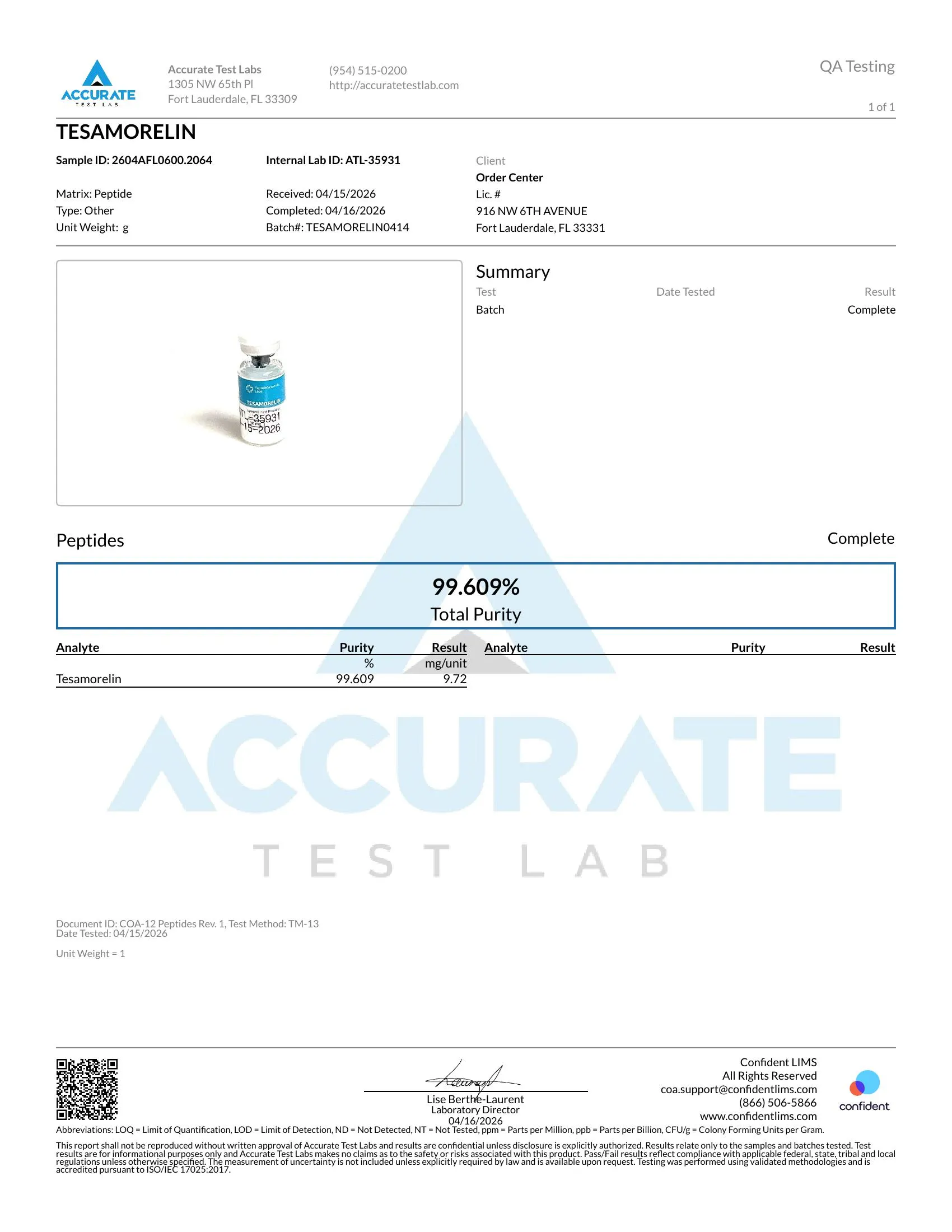
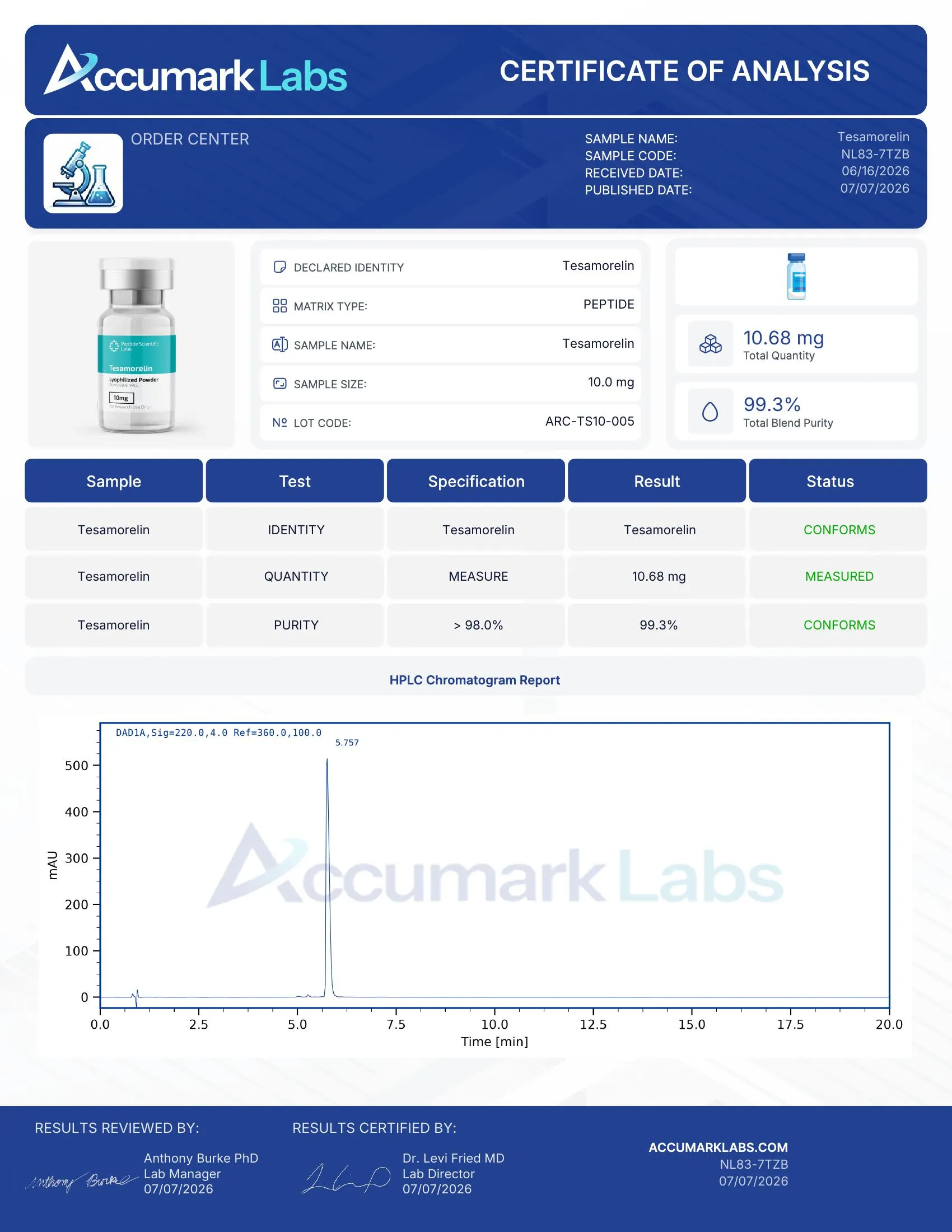
Every vial is produced with attention to contamination control and material traceability. Batches are assessed with analytical methods such as HPLC and LC-MS for identity and purity, and are screened for sterility and endotoxin as applicable to research-grade standards. Each unit is lot tracked, secured with tamper-evident packaging, and shipped via temperature-controlled logistics to protect compound stability in transit.
Peptide Scientific Labs operates with a quality-first mindset: careful raw material qualification, documented handling, and consistent manufacturing practices. Our aim is to reduce variability at each step—from sourcing to final packaging—so your laboratory can focus on building sound, reproducible data. Certificates of Analysis are available by lot to support documentation requirements and method transparency.
Research Use Only: This material is furnished strictly for laboratory research, forensic, or analytical purposes by qualified professionals. Not for human consumption, medical, veterinary, or household use. Do not inject, ingest, or apply to the body. Handle using appropriate laboratory safety procedures and institutional guidelines.
Choose Peptide Scientific Labs for a dependable USA-based source where purity, consistency, and transparency are non-negotiable—so each vial of Tesamorelin arrives ready for serious scientific work.
- Most orders ship within 24 hours and arrive within 3 to 5 days of leaving our warehouse.
- Shipping is free on orders of $99+ (except Hawaii and Alaska).
- All orders ship in discreet packaging via USPS Ground Advantage mail.
Delivery restrictions vary by state.

This Product Contains

Customer Reviews
There are no reviews yet. Be the first to write a review!

Frequently Asked Questions
What is Tesamorelin?
Tesamorelin is a synthetic analog of growth hormone-releasing hormone. It belongs to the same broad family as other GHRH-based peptides, but it is typically discussed as a distinct compound with its own pharmacologic profile. For a research-products site, it should be described as a laboratory peptide for GH-axis and metabolic-endocrine studies.
What is Tesamorelin typically studied for?
Tesamorelin is commonly studied for endogenous growth-hormone release, IGF-1 signaling, and body-composition or visceral-fat-related endocrine models. The best FAQ wording stays close to those research themes and avoids translating them into simplistic consumer promises.
What are GH peptides?
GH peptides — short for growth-hormone-related peptides — are a research category that includes two main subgroups. The first is growth-hormone-releasing hormone (GHRH) analogs, such as Sermorelin, Tesamorelin, and CJC-1295, which are studied for their interaction with the GHRH receptor. The second is growth hormone secretagogues, such as Ipamorelin, GHRP-2, GHRP-6, and Hexarelin, which are studied for their interaction with the ghrelin receptor (GHS-R1a).
Both subgroups are investigated in the research context of growth-hormone-axis biology. All GH peptide products from Peptide Scientific Labs are lyophilized research compounds intended solely for in vitro laboratory investigation.
How do GH peptides differ from recombinant growth hormone?
Recombinant human growth hormone is the full 191-amino-acid human GH protein, produced via recombinant DNA technology. It is essentially identical to the endogenous hormone itself. GH peptides, by contrast, are much shorter sequences — typically on the order of a few to a few dozen amino acids — that do not act as GH themselves but rather engage upstream receptors (GHRH-R or GHS-R1a) involved in the GH signaling axis.
This makes the two categories mechanistically distinct. Recombinant GH is a replacement of the hormone itself, while GH peptides are research tools for studying the regulatory machinery that controls endogenous GH release.
What is the difference between GHRH analogs and GH secretagogues?
GHRH analogs are peptides modeled on the natural growth-hormone-releasing hormone sequence. They are studied for their ability to bind the GHRH receptor on the pituitary — the same receptor used by endogenous GHRH. Examples include Sermorelin (a GHRH 1-29 analog), Tesamorelin, and CJC-1295.
GH secretagogues are a structurally different class of peptides that act through the growth hormone secretagogue receptor (GHS-R1a), better known as the ghrelin receptor. Examples include Ipamorelin, GHRP-2, GHRP-6, and Hexarelin. The two classes engage different receptors and are therefore studied as distinct pharmacological families in research on GH signaling.